

This morning, Canada and China announced a new strategic partnership including an agreement to facilitate trade in EVs, canola, and steel, as well as broader cooperation on multilateralism and investment.
The agreement represents Prime Minister Carney’s boldest move yet in his efforts to build international partnerships that reduce reliance on the United States. The challenge with this agreement is to thread the needle between seizing the opportunity that trade with China represents and not further alienating Canada’s southern neighbour.
The deal is smart: it attempts to achieve some limited gains from cooperation while pointing the way to deeper engagement in the future.
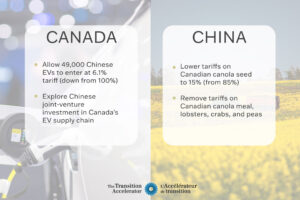
In order to secure the removal of canola tariffs, Canada will allow 49,000 Chinese EVs to enter the Canadian market at a 6.1% tariff rate. This corresponds to Canadian imports in the year prior to the imposition of the 100% tariff.
This does not directly change Canada’s overall tariff rate, thus technically keeping Canada aligned with U.S. tariffs on EVs.
There is also an agreement on extending remission measures for certain kinds of Chinese steel and aluminum products that are not made in Canada.
It will be interesting to see what comes of the agreement between NRCan and their Chinese counterparts on modern wood construction. Diversifying trade in wood, especially mass timber and modular construction, by increasing trade with Asia, is an important long-term play for Canada.
While no Chinese investment in Canada was announced at this time, the two sides agreed to explore partnerships in Canada’s EV supply chain. A joint venture between Canada and a Chinese partner could, if done right, help to bring Chinese technology and know-how to Canada’s manufacturing base. Learning from China would be a major boon to Canadian industrial strategy.
Allowing some Chinese EVs into the country is also smart, especially if these end up being low-cost, sub-$35k EVs. But before the tariffs, the majority of Chinese imports were Teslas made in Shanghai.
Still, in industrial policy, selective exposure to your best competitors is good. It enables domestic manufacturers to be disciplined. Unrestricted exposure could wipe out domestic gains, but some competition from low-cost, high-quality importers forces producers to raise their game and learn. This drives innovation and productivity.
These two tools—joint ventures with and selective exposure to the best firms—were essential to the success of China’s industrial strategy. And they could be an essential piece of a revamped EV industrial strategy in Canada.
For Canada, the ideal situation is that selective exposure and Chinese investment increase the competitiveness of Canadian EV manufacturing without alienating the United States or creating a liability in CUSMA renegotiations. After all, by opening its market to China, Canada effectively opens the U.S. market to China. Perhaps the Trump administration will not care about EVs, but it is a risk.
In geopolitical terms, this could potentially represent a major shift. Under the Biden administration, Canada moved away from China and aligned itself with hawkish U.S. policy. Under Trump, Canada is now hedging. That is a win for China.
By combining selective market exposure with potential joint ventures, Canada is borrowing from the playbook that built China’s own manufacturing prowess. The real test is whether Canadian policymakers can manage the geopolitical tightrope—leveraging Chinese competition and capital without triggering U.S. retaliation. If they can, this deal becomes a template for strategic interdependence.
For more on Canadian trade diversification, see the report « Exporting the Future Economy. »